







 > 국내도서 요약 > > 국내도서 요약 > |
국내도서 요약 |
| 경제경영전체 |
| 경영자스토리 |
| 리더십 |
| 경영전략/혁신 |
| 마케팅 세일즈 |
| 트렌드/미래예측 |
| 경제 |
| 재테크/투자 |
| 창업/취업 |
| e-비즈니스 |
| 자기계발 |
|
| 인문교양전체 |
| 인문학 |
| 역사 |
| 사회과학 |
| 자연과과학 |
| 예술/대중문화 |
| 인물/평전 |
| 종교 |
| 교육/육아/학습 |
| 여행/취미/건강 |
| 산문/에세이/논픽션 |

 > 오디오북 > 영어오디오북
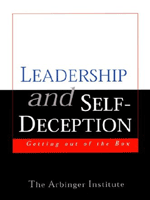
- Leadership and Self-Deception
- 저 자 The Arbringer Institute
- 출판사 Berret-Koehler Publishers Inc.
- 가 격 $14.95(180 Pages)
- 출판일 2002년 01월


본 도서요약본은 네오넷코리아가 해당 출판사의 허가 및 검수를 거쳐 제작된 컨텐츠입니다. - 저작권 관련 문의처 : 해냄법률사무소 황도수변호사 02)541-7233

■ The Big
Idea
How would you react
if you were told by your top boss that you have a problem and that problem is
you ? only you don’t know how on earth you can be THE problem? Sounds confusing,
doesn’t it? Well, in this simple, practical, enlightening, maybe even
life-changing business book from the Arbringer Institute, you’ll find that at
the center of most organizational problems is the human frailty of
Self-Deception.
With its easy-to-read narrative style and analogy by common life examples, you’ll find the concepts and principles adaptable to any work environment. Sometimes, you’ll hardly feel that you’re reading a business book because the subject is deeply rooted on how you behave as an individual, as a person and thus, may also be applied to your everyday life.
■ About the
Author
The
Arbringer Institute
BYU philosophy professor C. Terry Warner, 63,
never set out to be an organizational consultant, but in the late 1970s, Stephen
R. Covey, learned about his work on self-betrayal and thought the concepts might
help one of his clients. Using Warners ideas, the company went from being
nearly torn apart by internal conflict to becoming the most profitable company
in the steel service industry.
In this experience Warner discovered that working with organizations could provide him with a laboratory of living subjects that anchored his theoretical work to practical realities and motivated thousands of people to share stories with him.
At a crucial point, Warner was counseled by the BYU administration to develop and gain legitimacy for his ideas off campus as practical tools for helping people. In 1992, he let his occasional consulting practice expand into a small company, The Arbinger Institute, and three key employees were made partners in the mid 1990s.
On three occasions Warner has taken a one-year leave of absence from BYU or had his time purchased to work fulltime on Arbinger projects. Otherwise he has averaged only a day or two a year on Arbinger concerns. His partners, whom he calls "princely men of great ability," have developed and run the institute. He didnt even read the institutes best-selling book, Leadership and Self-Deception, until it was published, though it is based solely on his previous works.